

Holocene from Wästberg
lamps without electricity
As is customary, Wästberg, in collaboration with leading architects and designers, creates aesthetically pleasing luminaires with advanced technology, sometimes even dispensing with electricity altogether.

Holocene No. 7: Ingegerd Råman
Always faithful to the habit of keeping a flower by the bed, the renowned Swedish glass and ceramic designer, Råman, explored many different expressions of the same concept between 1968 and 1995: a thin glass vase for a flower, with a clever lid that fits snugly inside and can be inverted to become a candlestick. Years later, Holocene No. 7 innovated this design, adding a polished steel base that subtly recalls and celebrates the reflective nature of the glass body.

Holocene No. 6: Ilse Crawford
Holocene No. 6 embodies the vibrant beauty of candlelight preserved within an object. Its solid, opulent brass dish features a highly reflective finish and a wide, flat rim. At the center of the dish is a sharp pin for securing a candle.

Holocene No. 5: David Chipperfield
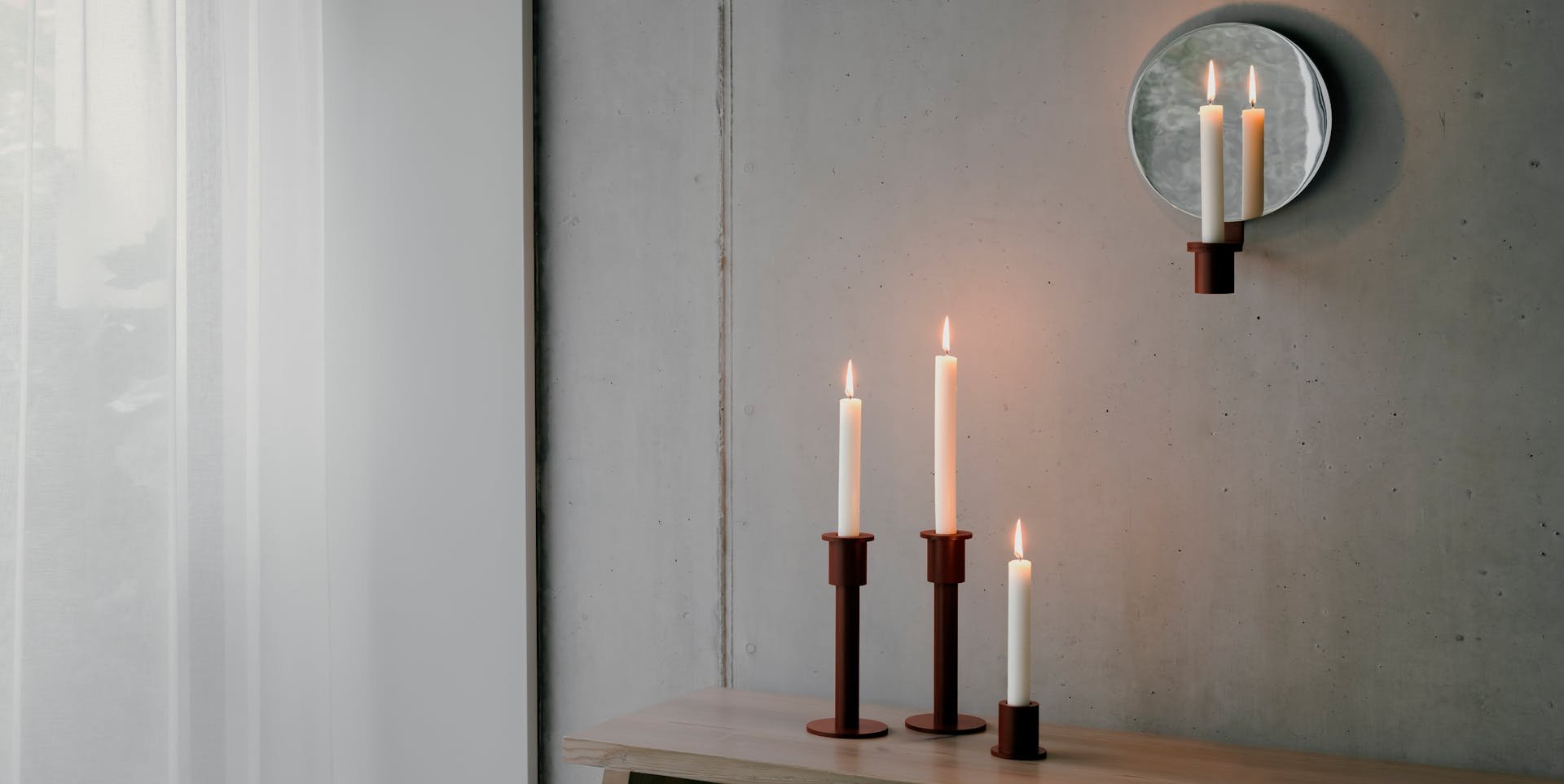
Holocene No. 5 explores the intriguing interactions of reflected light, as well as the idea of a simple object that can be used in many different ways. It employs the age-old technique of combining wall lights with mirrors to enhance light reflection – here in a striking version that is both modern and timeless enough for any setting.

Holocene No. 4: John Pawson
Pawson's design for Holocene No. 4 draws inspiration from the oil lamp and meticulously reduces it to its functional, formal, and chromatic essence, as a vessel of fire, that can be carried or hung.

Holocene No. 3: Jasper Morrison
Holocene No. 3 is not only visually appealing with its polished brass surface and soft, rounded shape; its substantial weight and solid feel make it a pleasure to touch and hold.

Holocene No. 2: David Chipperfield
While the sleek brass of Holocene No. 2 serves as an homage to the classic oil lamp, its construction offers a more creative and interactive approach. Along the circumference of the round base – which stores the lamp oil – are two curved reflectors that can slide gently.

Holocene No. 1: Ilse Crawford
Holocene No. 1 celebrates the simplicity and beauty of a single flame, surrounding it with a reflective pool of oil, giving the impression that the flame is floating. Housed in a generously sized solid brass dish, this modern oil lamp suits any surface, creating both atmosphere and ambient reflection.
Holocene.
I.
Fire was given to mankind by the god Prometheus, unless it was lightning. Man learned to keep the fire burning – and if necessary, to rekindle it. Man owes fire a great deal.
II.
Fire allowed man to move down from the trees.
Fire allowed us to keep caves warm and ward off predators.
Fire allowed us to interact with each other and become social beings. Fire allowed us to refine weapons, tools and utensils.
Fire allowed us to transform nature to hunt and farm more effectively. Fire allowed us to cook food – and develop larger brains.
Larger brains allowed for even more heated discussions around the fire.
III.
Fire allowed man to conquer a continent.
Fire allowed the industrialization of the world.
Industrialization fueled ruthless exploitation.
Ruthless exploitation caused more stress for humans.
Electricity further increased the level of stress, now we can work around the clock.
With spotlights on the office ceiling, helplessness increased.
The feeling of helplessness ended the heated discussions around the fire.
IV.
The once promising Holocene has given way to the Anthropocene and a newly founded Swedish lighting company realized that something had to be done: A massive systemic failure had occurred. The human-scale space of man had to be restored. The lamps should not shine away from people from above, but spread well-being close to people. Wästberg, the name of the company, has partnered with some of the world's leading designers to create lamps that are both beautiful, technically perfect and energy efficient. Eventually, the rest of the world began to realize the extent of the system's failure. As well as how to cure it.
V.
After less than a decade in operation, Wästberg decided to take another step back in history - and launched light sources that do not require electricity. Once again, some of the world's leading designers were invited to collaborate. The name of the light sources was obvious. Holocene can be seen as a tribute to fire. As well as to humans.
